- HOME
- Solution
- AI Workforce
AI Workforce
POSCO DX completes the innovation of corporate work styles by providing AI Workforce services that understand situations, make judgments, and collaborate seamlessly with humans.
Office / Manufacturing Business Innovation
We define and operate AI Agents as 'AI Employees' in the office sector and 'AI Operators' in the manufacturing sector.
Through the integrated platform 'Agentee,' we continuously create, nurture, and manage them to drive innovation in the way we work.
AI Employee (Colleagues beyond the PC)
AI executes everything from simple/repetitive tasks to specialized/judgmental work
Redesigning Work from a Human-AI Collaboration Perspective
AI Operator(The Brain in the Control Room) + Robot (The Hands and Feet on the Field)
AI takes charge of operating the control room on the manufacturing site.
Robots perform field tasks based on AI driver instructions
Agentee(AI Workforce Platform)
AI platform for creating, managing, collaborating with, and evaluating AI Agents like employees
Integrated management of the AI Agent Life Cycle linked with existing business systems
P-GPT(Private GPT)
POSCO Group-exclusive Generative AI service developed and operated by POSCO DX
Providing customized services tailored to work environments and security requirements
AI Employee
It is an autonomous digital colleague that performs specific roles in the office field, an 'action-oriented AI' that continuously learns, grows, and solves problems alongside employees.
AI Employee Configuration
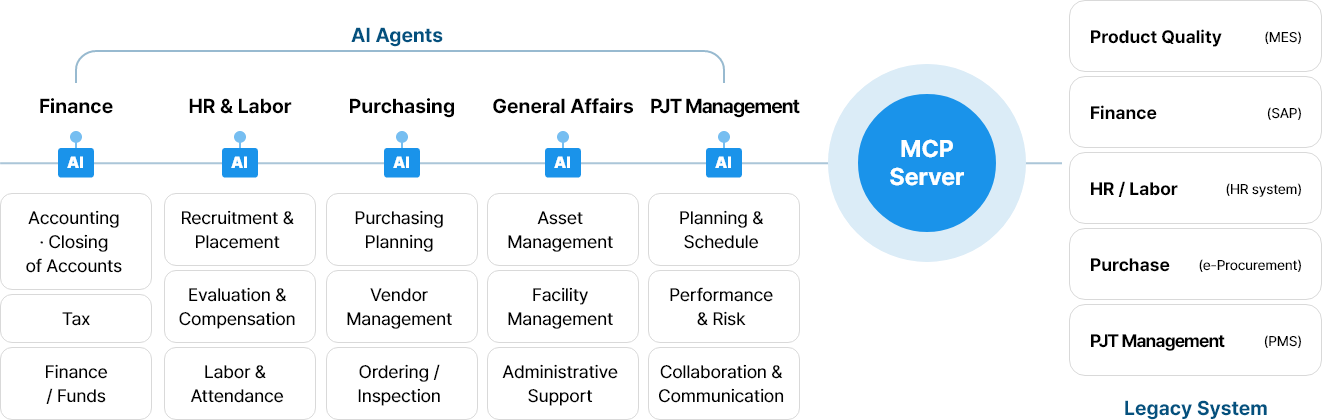
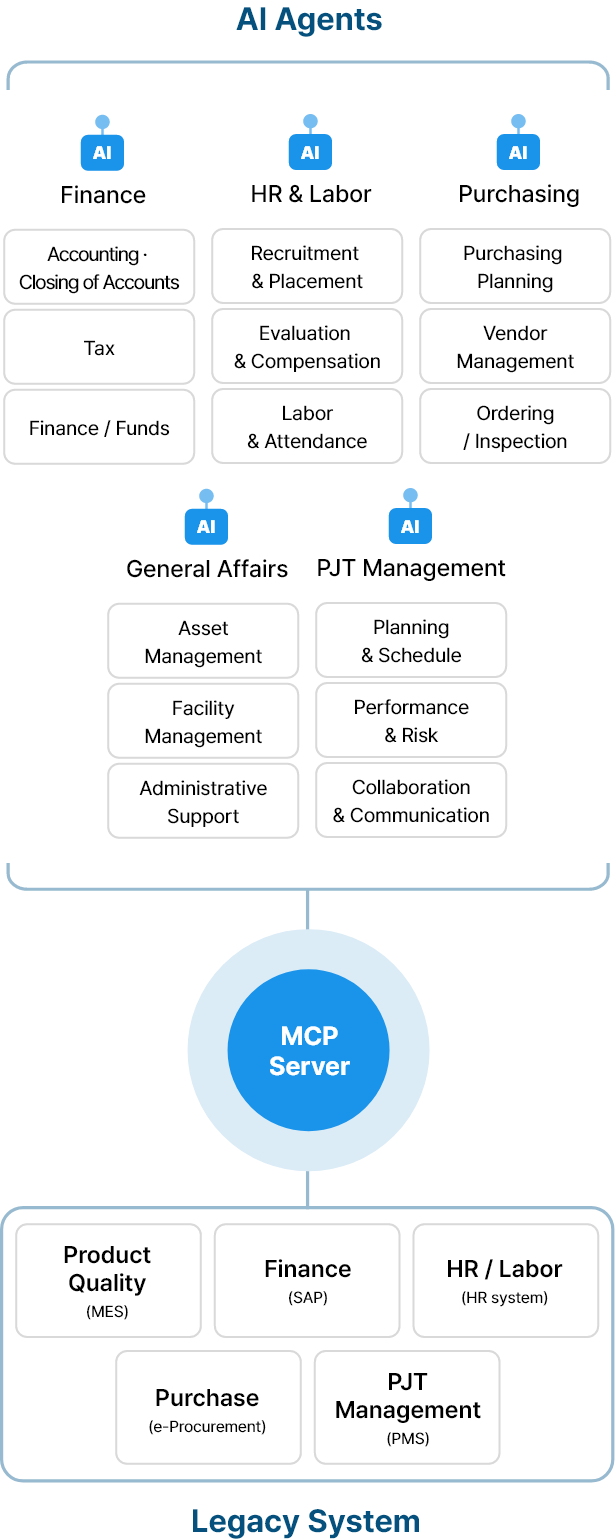
This image explains the structure where 5 areas of office AI agents are linked to legacy systems via an MCP server.
-
1. AI Agents Functions by Area
- Finance : Accounting/Closing of Accounts, Tax, Finance/Funds
- HR & Labor : Recruitment & Placement, Evaluation & Compensation, Labor & Attendance
- Purchasing : Purchasing Planning, Vendor Management, Ordering/Inspection
- General Affairs : Asset Management, Facility Management, Administrative Support
- PJT Management : Planning & Schedule, Performance & Risk, Collaboration & Communication
-
2. MCP Server
Centrally mediates data between agents and legacy systems.
-
3. Legacy System
Connected to Product Quality(MES), Finance(SAP), HR/Labor(HR system), Purchase(e-Procurement), and PJT Management(PMS).
Special Features
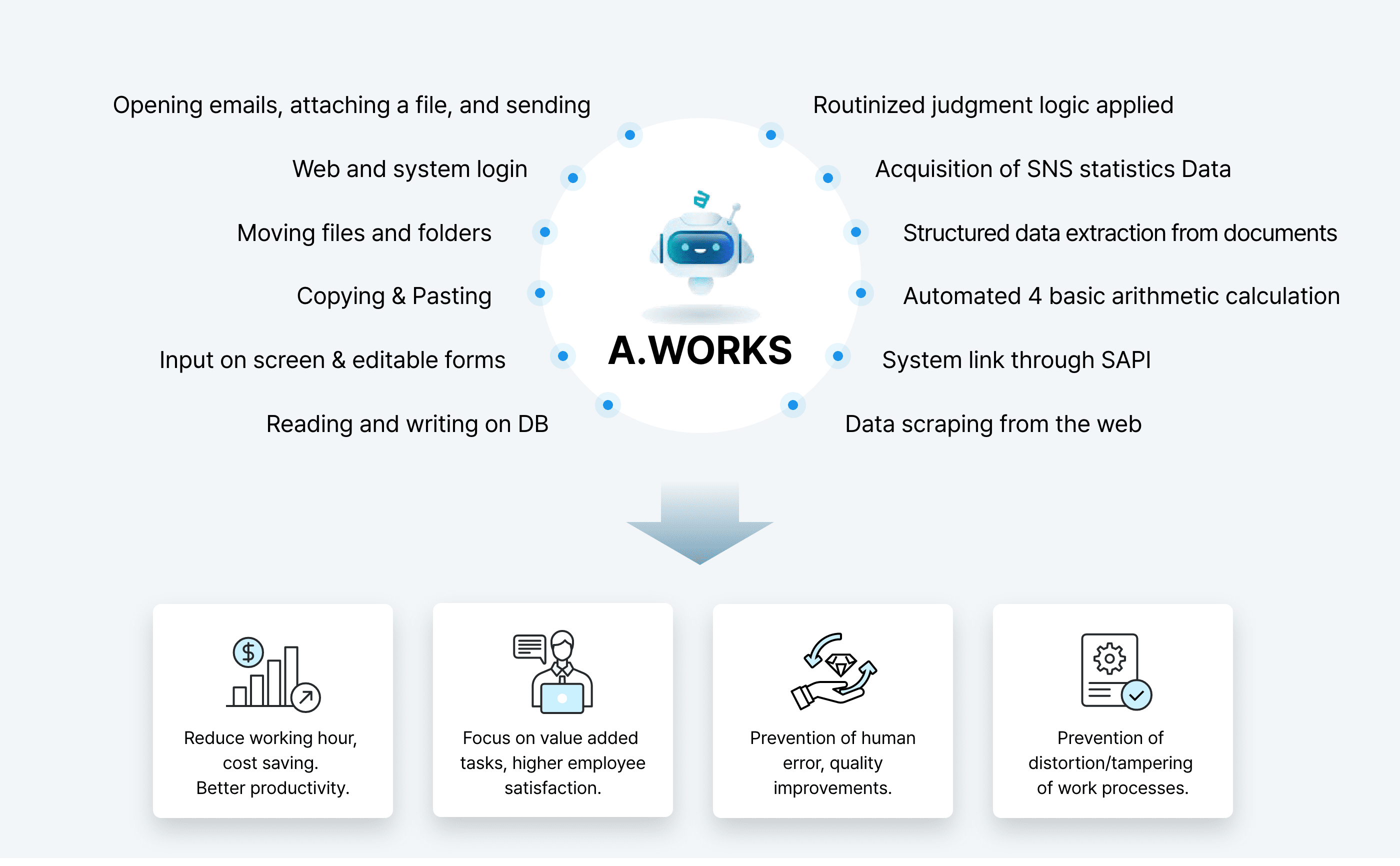
- Reduced work hours and maximized productivity : AI-automated execution of simple, repetitive, and data-driven tasks
- Change in employee roles : Transition from simple executors to high-value-added work centered on planning, management, and decision-making
- Accumulation and utilization of organizational knowledge assets : Formalization of LLM-based tacit work know-how of skilled workers
- Workforce efficiency and work quality standardization : Work redesign from a Human-AI Collaboration Perspective
Key Application Cases
Promoting the application of AI Agents to simple/repetitive and rule-based tasks
- Introducing 113 types of AI employees to office tasks such as accounting/tax, HR/labor, and price estimation
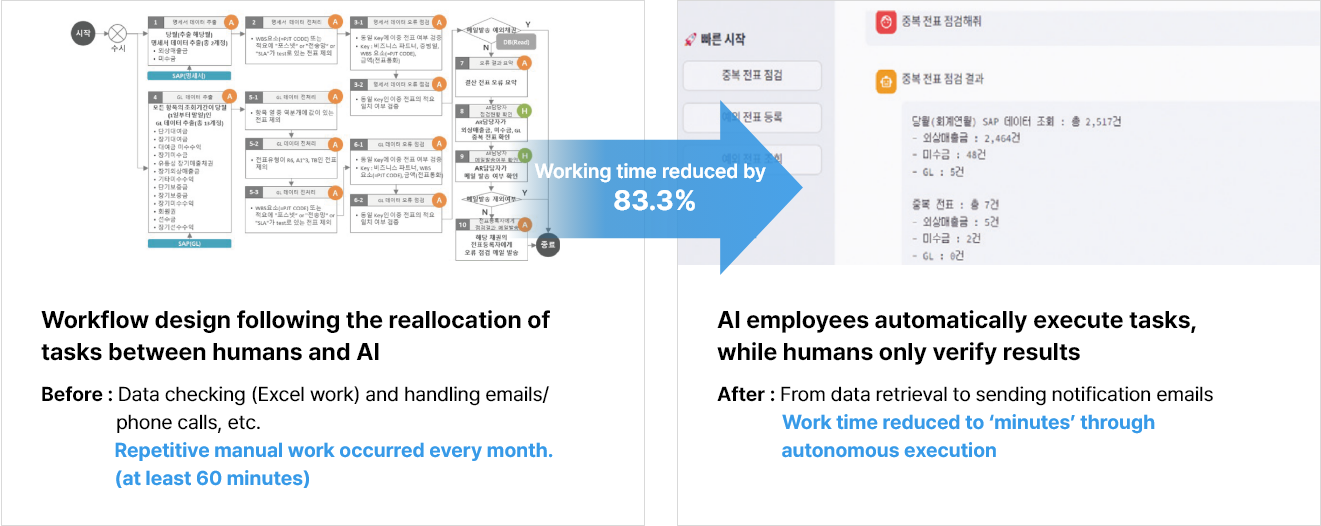
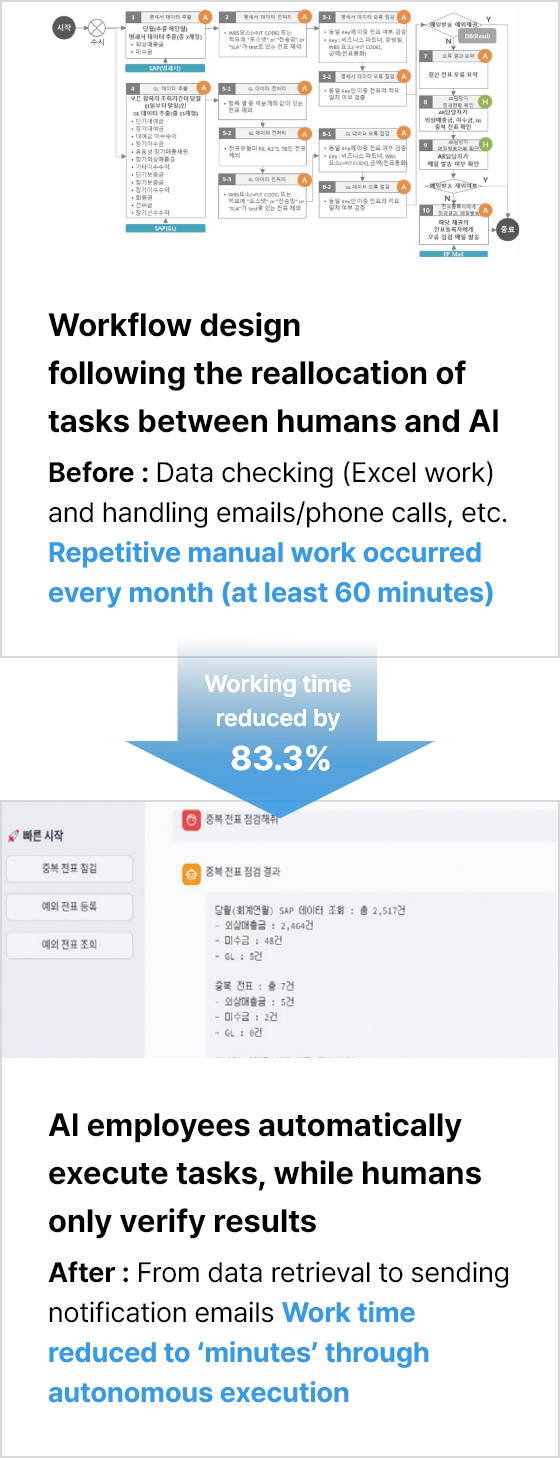
Workflow design following the reallocation of tasks between humans and AI
Working time reduced by 83.3% through work redesign.
-
Before:
Data checking (Excel work) and handling emails/phone calls, etc. Repetitive manual work occurred every month (at least 60 minutes).
- Result: Working time reduced by 83.3%
-
After: AI employees automatically execute tasks, while humans only verify results
From data retrieval to sending notification emails, work time reduced to 'minutes' through autonomous execution.
Introduction of ‘Business Analysis AI Staff’ to perform multi-layered business analysis and report generation with just a single line of prompt
- Enabling non-experts to easily analyze data through ontology-based APIs created by AI understanding data context
- Reducing business analysis time by 70–90%
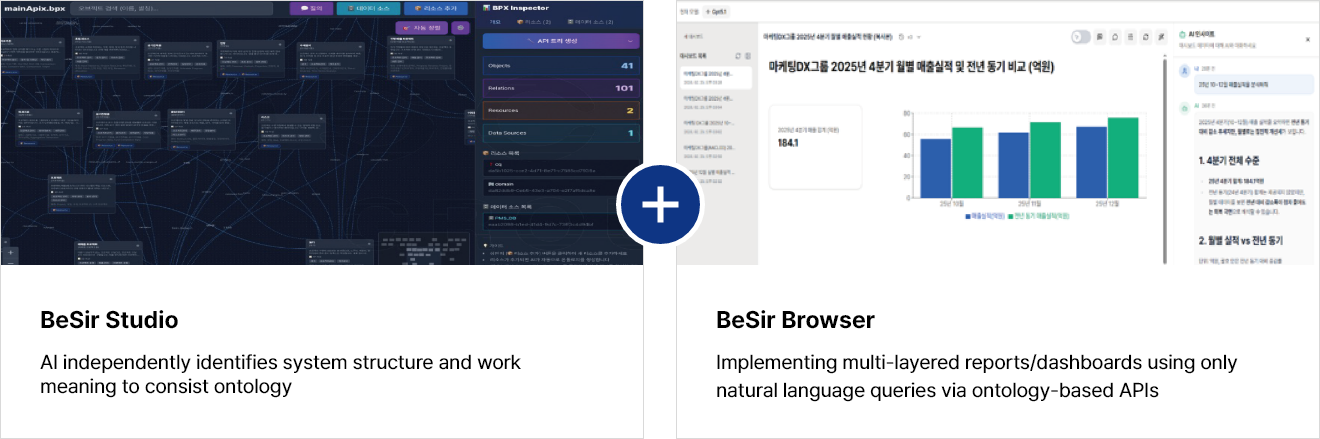
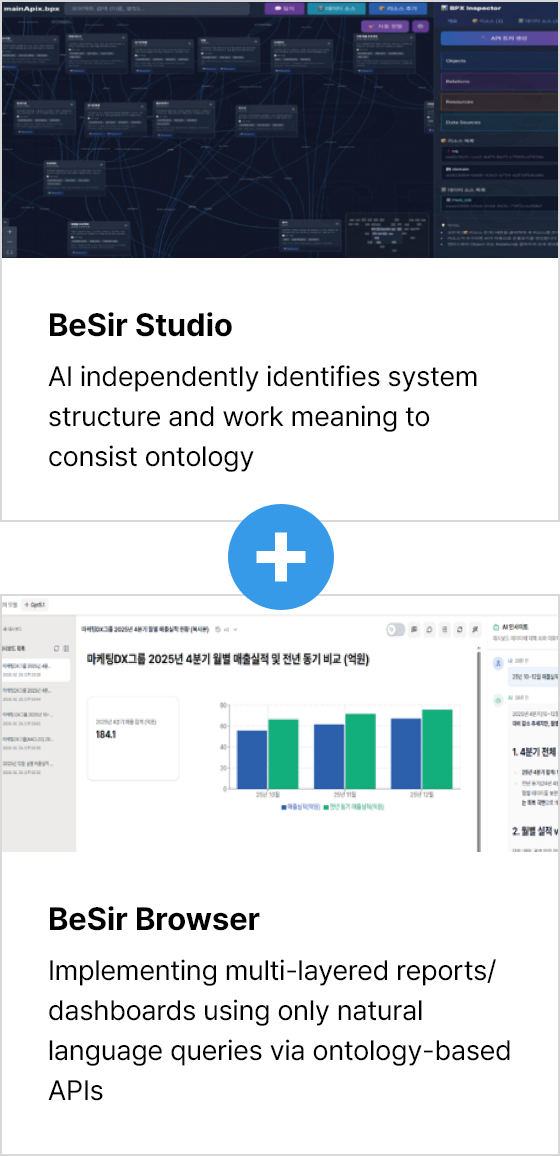
BeSir Solution: BeSir Studio and BeSir Browser
-
BeSir Studio
AI independently identifies system structure and work meaning to consist ontology.
-
BeSir Browser
Implementing multi-layered reports/dashboards using only natural language queries via ontology-based APIs.
AI Operator
The AI Operator is a virtual employee that utilizes a Multi AI Agent model to monitor, make decisions on, and even control operations on the manufacturing floor without operator intervention.
Necessity of AI Operators
- Demographic cliff, aging population, and worsening labor shortages : Need to establish a system for transferring operational know-how to prepare for potential technology gaps arising from staffing difficulties.
- Limitations of existing work methods : Repetitive and rule-based tasks can be automated, but actual field operations frequently involve the recognition and judgment of exceptional situations.
- Increased operational complexity : The diversity of equipment, systems, and data increases the amount of information operators must manage -> Impossible to monitor all statuses.
- Increased demand for operational efficiency and stability : Growing need for systems that manage more facilities with fewer personnel.
Operating system
Operator Operation
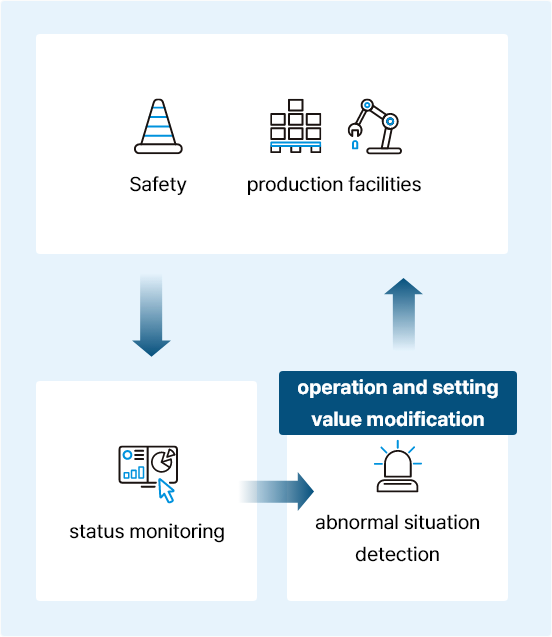
A cycle where human operators control the facilities.
- Status monitoring: Operator checks safety and production facilities.
- Abnormal situation detection: Operator judges the situation based on monitored data.
- Operation and setting value modification: Operator manually controls or modifies settings.

AI Operator Operation
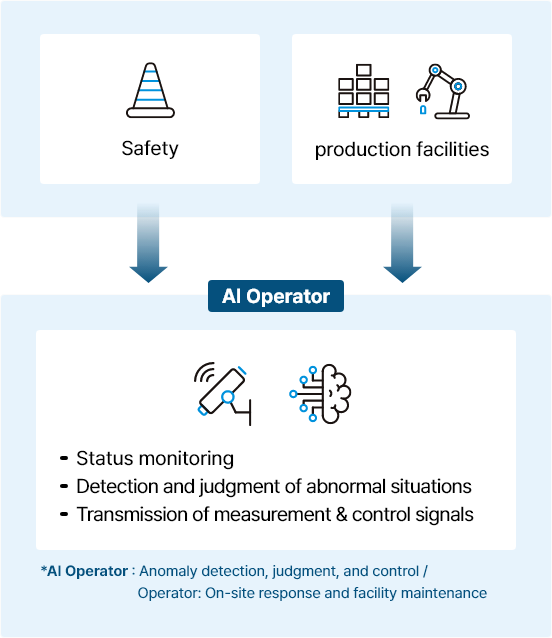
AI autonomously judges and controls, while humans focus on advanced management.
- AI Operator: Status monitoring, Detection and judgment of abnormal situations, Transmission of measurement & control signals.
- Role division: AI Operator handles anomaly detection, judgment, and control. Operator handles on-site response and facility maintenance.
| Category | Conventional Automation | AI Operator (Autonomous Intelligence) |
|---|---|---|
| Decision-Making |
Rule-based control - Executes predefined instructions (Input A → Action B) |
LLM/VLM-driven autonomous control - Context-aware reasoning and adaptive decision-making |
| Adaptability | Operates effectively only in fixed environments - Requires controlled conditions such as lighting and positioning |
Dynamically adapts to changing environments - Supports real-time visual recognition and situational response |
| Data Utilization | Threshold-based data processing - Simple condition comparison and rule execution |
AI-powered correlation analysis and insight generation - Enables predictive analytics and intelligent optimization |
Expected Benefits
-
- Improved quality stability
- Automatic optimization of process conditions
-
- Increased production efficiency
- Elimination of unnecessary waiting time,
reduction of overload and errors
-
- Reduced operating costs
through collaboration - [AI Operator] Repetitive monitoring,
complex data analysis and control
[Operator] On-site response and equipment maintenance
- Reduced operating costs
-
- Accumulation and reuse
of knowledge - Internalization of experience-based know-how into the AI model
- Accumulation and reuse
Agentee (AI Workforce Platform)
It is a core platform that comprehensively manages the entire lifecycle of AI Agents—from creation and operation to improvement and redeployment—enabling enterprises to leverage AI with maximum efficiency.

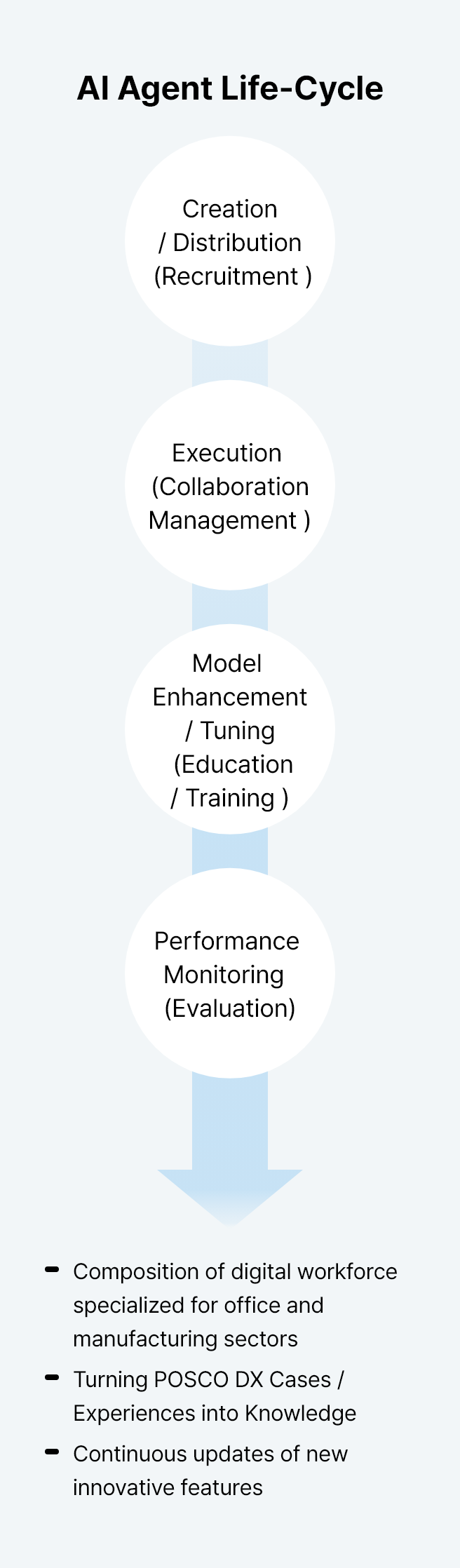
AI Agent Life-Cycle
- Creation / Distribution (Recruitment)
- Execution (Collaboration Management)
- Model Enhancement / Tuning (Education / Training)
- Performance Monitoring (Evaluation)
- Key Features
- Composition of digital workforce specialized for office and manufacturing sectors
- Turning POSCO DX Cases / Experiences into Knowledge
- Continuous updates of new innovative features
Special Features
Rapid deployment and integrated lifecycle management of AI Agents linked to existing business systems
- Easy and fast AI Agent creation through collaboration between non-developers and developers
- Operational management of the AI Agent lifecycle from creation to monitoring
- Flexible scalability and integration with existing business systems and communication tools (M365, Teams)
- Provision of an efficient deployment environment based on P-Cloud (Private Cloud)
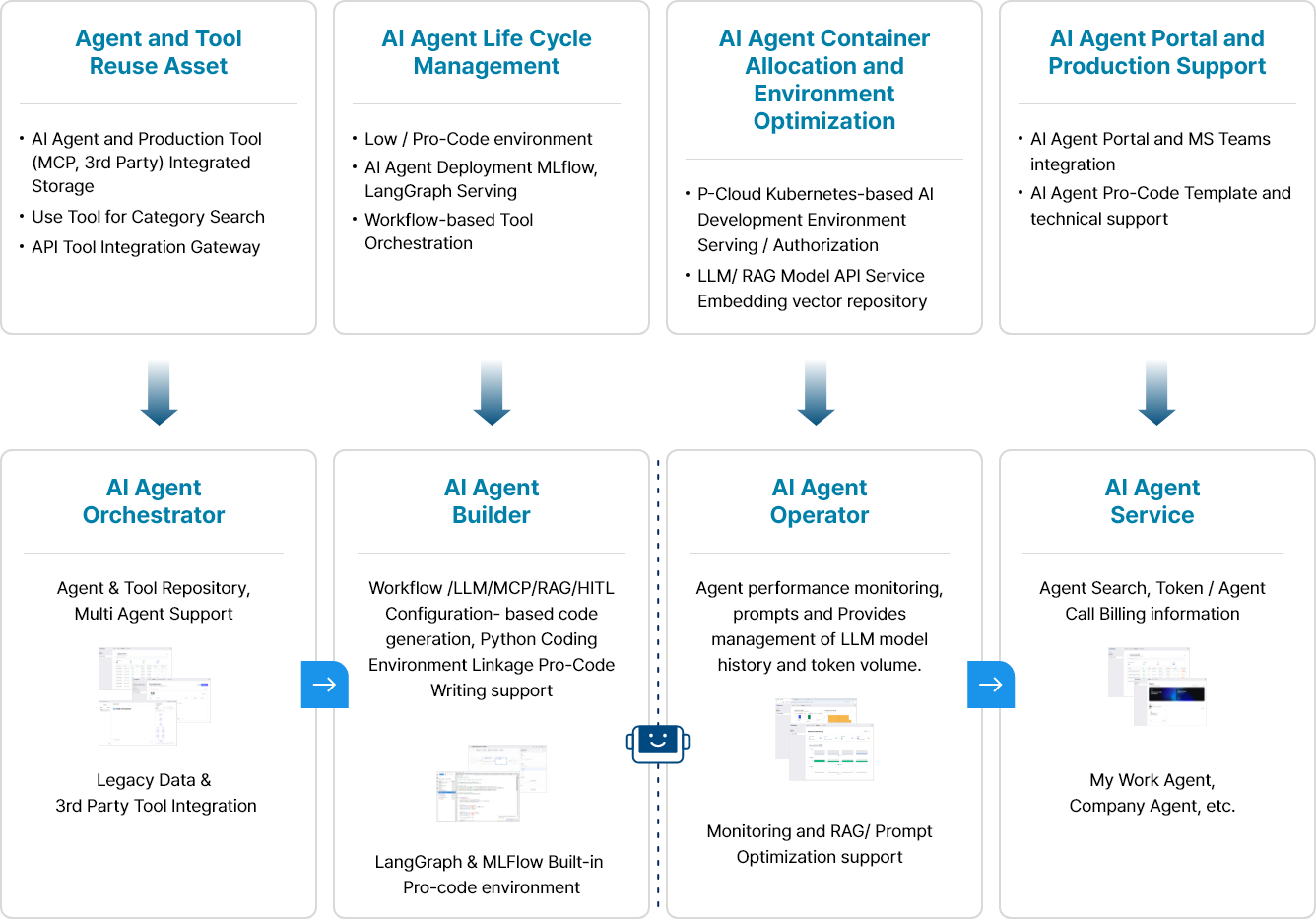
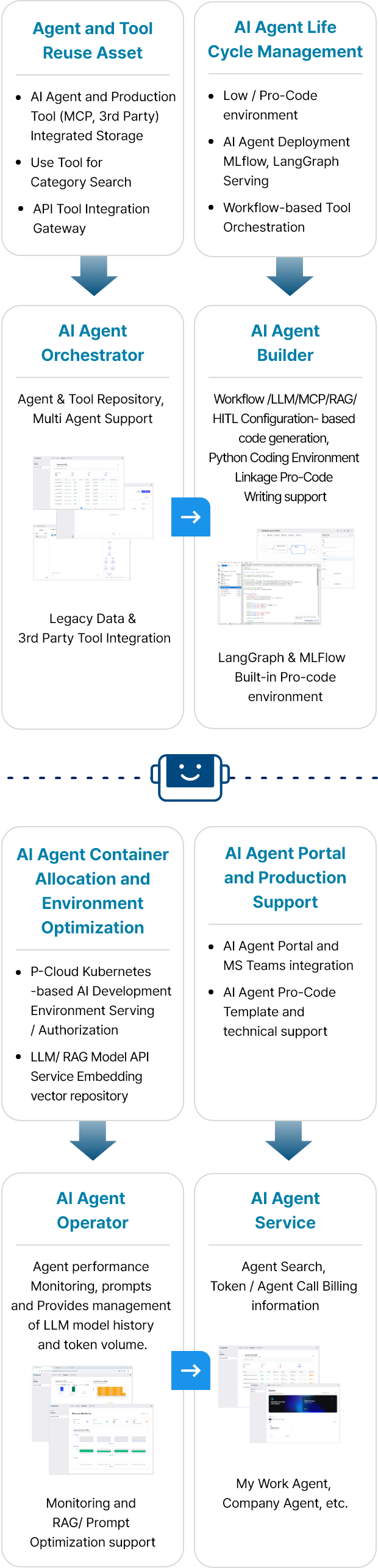
This image explains the 4 core areas for AI Agent reuse, lifecycle management, environment optimization, and production support.
-
- Top: Agent and Tool Reuse Asset
-
- AI Agent and Production Tool (MCP, 3rd Party) Integrated Storage
- Use Tool for Category Search
- API Tool Integration Gateway
- Bottom: AI Agent Orchestrator
-
- Agent & Tool Repository, Multi Agent Support
- Legacy Data & 3rd Party Tool Integration
-
- Top: AI Agent Life Cycle Management
-
- Low / Pro-Code environment
- AI Agent Deployment MLflow, LangGraph Serving
- Workflow-based Tool Orchestration
- Bottom: AI Agent Builder
-
- Workflow / LLM / MCP / RAG / HITL Configuration based code generation, Python Coding Environment Linkage Pro-Code Writing support
- LangGraph & MLflow Built-in Pro-code environment
-
- Top: AI Agent Container Allocation and Environment Optimization
-
- P-Cloud Kubernetes-based AI Development Environment Serving / Authorization
- LLM / RAG Model API Service Embedding vector repository
- Bottom: AI Agent Operator
-
- Agent performance monitoring, prompts and Provides management of LLM model history and token volume.
- Monitoring and RAG / Prompt Optimization support
-
- Top: AI Agent Portal and Production Support
-
- AI Agent Portal and MS Teams integration
- AI Agent Pro-Code Template and technical support
- Bottom: AI Agent Service
-
- Agent Search, Token / Agent Call Billing information
- My Work Agent, Company Agent, etc.
P-GPT (Private GPT)
P-GPT is POSCO Group exclusive generative AI service developed and operated by POSCO DX. Based on Large-Scale Language Models (LLM), it provides customized services tailored to the company's business environment and security requirements.
Key Features
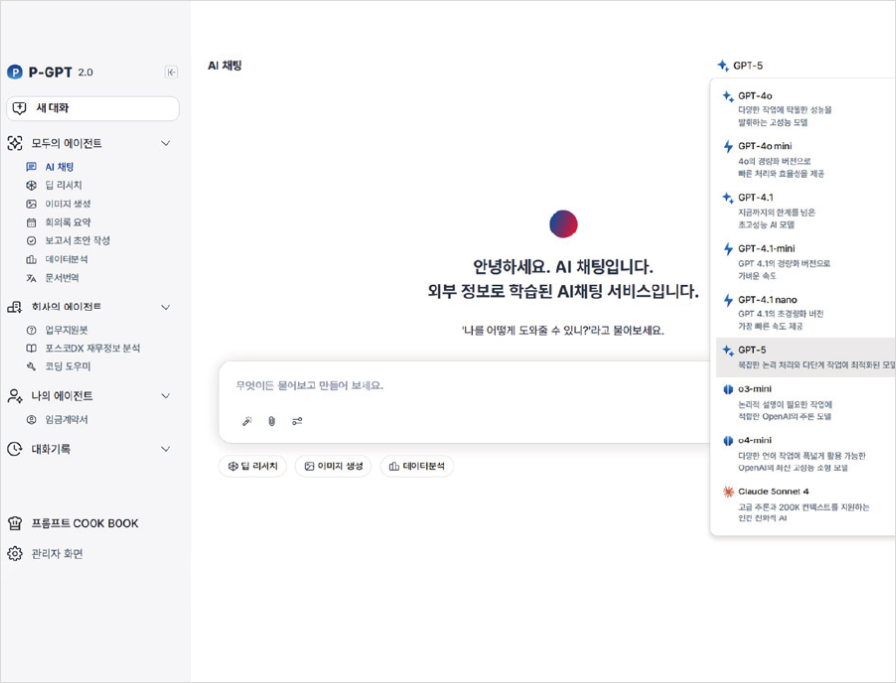
Provides rapid upgrades to the latest models based on multi-LM, and advanced agent features such as deep research and data analysis.
- Agent for All
-
- An AI agent shared by all members
- Supports AI chat, deep research, image generation, meeting minutes summarization, data analysis, etc.
- Company Agent
-
- AI agents dedicated to specific departments or projects within the company
- Customized support based on departmental documents, business processes, and project data
- My Agent
-
- An AI agent for personal task assistance
- Provides personalized features through personal document learning and prompts
- Administrator Functions
-
- Data upload management, permission settings, usage log monitoring
- Announcement management, monthly expense inquiry and settlement
Operating system
Integration of semantic-based contextual search utilizing a Vector DB and generative AI response functions by registering and training internal documents in the RAG+LLM-based P-GPT
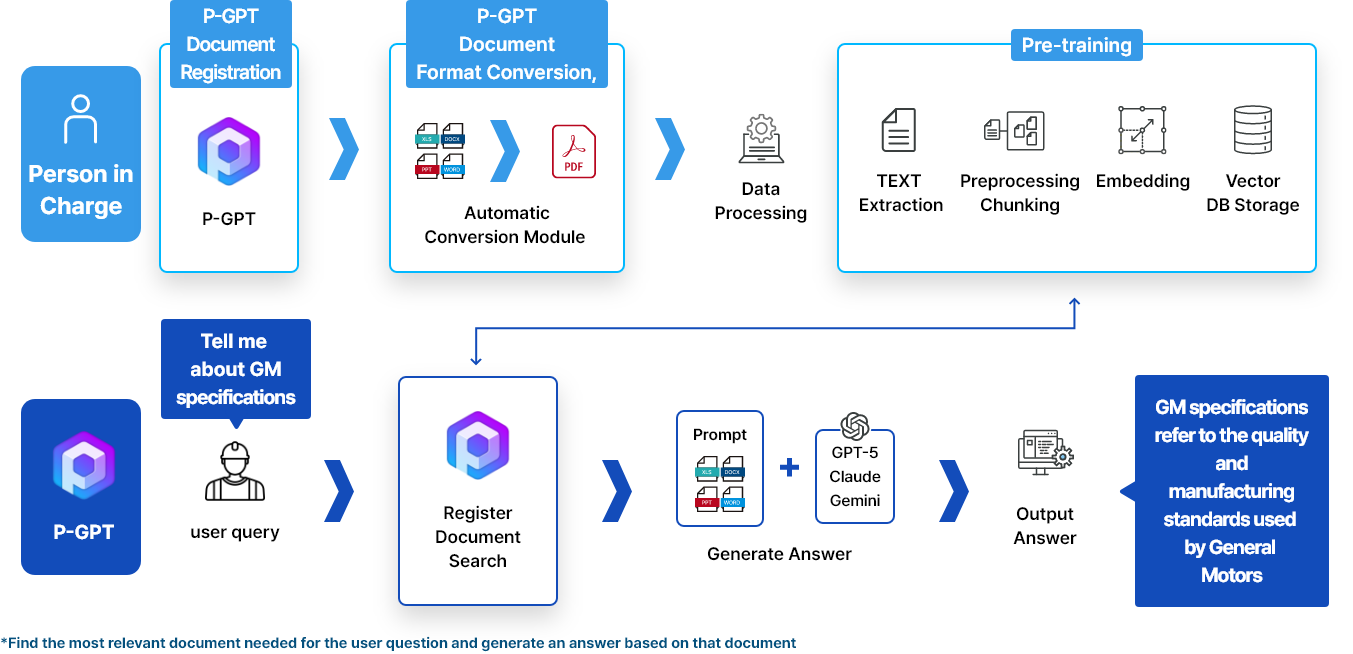
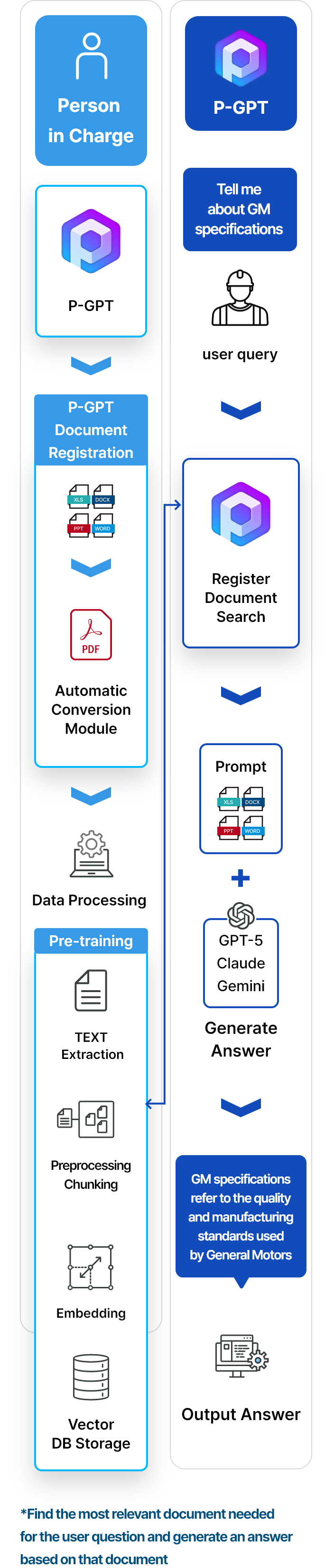
This image explains the 2-step process of registering documents and generating answers based on user queries.
-
Step 1: Document Registration and Knowledge Base (Top Process)
- Person in Charge & P-GPT Document Registration: Registers the original document to the P-GPT system.
- P-GPT Document Format Conversion: Automatic Conversion Module converts various formats into PDF.
- Data Processing & Pre-training: Goes through TEXT Extraction, Preprocessing Chunking, and Embedding.
- Vector DB Storage: The processed data is stored in the Vector DB.
-
Step 2: User Query and Answer Generation (Bottom Process)
- User Query: "Tell me about GM specifications"
- Register Document Search: P-GPT searches for the most relevant documents in the Vector DB.
- Generate Answer: Combines the prompt with LLM models (GPT-5, Claude, Gemini).
- Output Answer: Generates the answer: "GM specifications refer to the quality and manufacturing standards used by General Motors."
Find the most relevant document needed for the user question and generate an answer based on that document.